
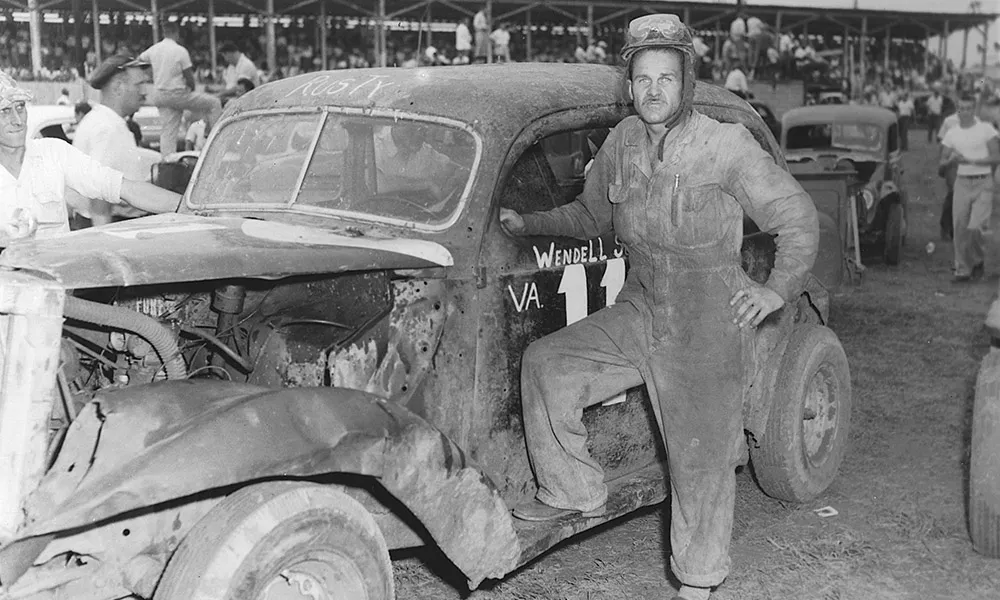
Not going to sugar coat it; Richard Pryor’s ‘Greased Lightning‘ is not great. But it has moments that make it worth watching. And there’s cool ‘car stuff‘ throughout, so gearheads will enjoy it as the film tells the real-life story of Wendell Scott, the first black man to win a NASCAR race.
The movie uses ‘time jumps’ to cover several decades. The opening scene shows young Wendell returning home to a segregated Virginia after serving in WWII. He cannot earn enough driving his 1939 Chevrolet Master DeLuxe taxicab, so he sidelines transporting illegal ‘moonshine’ whiskey in his V8 powered Ford 5-Window coupe. He skillfully evades the police for nearly 5 years before being caught. Rather than jail time, Scott is offered an opportunity;. He’ll be a gimmick at the local race track; the only black driver against very hostile white racers and spectators.


Despite death threats against him, Wendell races hard against white drivers who resort to dirty tactics like intentionally crashing into him. Interestingly, the grandstands weren’t filled with rednecks hoping to see a black man getting beaten (on track) instead the black community packed the segregated grandstands to cheer Wendell. Just competing and finishing a race in one piece was an accomplishment for Wendell, who had so many forces acting against him. His tenacity makes Wendell a hero in Danville, Virginia, and earns him the respect of fellow racers.


Wendell Scott was robbed of wins by track owners who did not want to see a black man victorious. As recently as a 1963 Grand National Series race in Jacksonville, Wendell won the race (by two laps) but scoring awarded the win to second-place driver, Buck Baker. Hours later, once the champagne has been sprayed, and the flashbulbs had popped, race official discovered their ‘mistake’ and gave the victory purse to Wendell.
Not mentioned in the movie is that Wendell never receive the trophy. The Jacksonville trophy was finally given to Scott’s family in 2021 – 58 years after the race, and 31 years after Wendell Scott died.
Films set in the recent past like ‘Greased Lightning‘ forces viewers to reflect on their world today by showing how bad things were not that long ago.
For example, while Wendell is initially despised by all his racing rivals, he eventually befriends a white driver named Hutch (played by Beau Bridges). Wendell wins a ‘free steak dinner for two’ for his 4th place finish at a local race. Opportunist Hutch advises Wendell to take him along. Aptly named The Colonial restaurant is segregated, but together the two men still manage to be served. They talked their way past the waitress, but confrontational customers harass Wendell until a fight breaks out. Hutch fends off the angry mob with a spear-shaped flag pole (with a Confederate flag on it) while Wendell carries their plates of food out the door, promising to return the silverware.
It’s sort of a victory for integration. The two men proudly finish their meals while sitting in the front seat of a pickup truck and Wendell offers Hutch a swig from his bottle of Coca Cola. After a pregnant pause, Hutch turns down the drink, refusing to drink from the same bottle as a black man. No matter how far we think we’ve come, we’re not there yet.


The movie then time-jumps to the early ’70s. Wendell is battered from years of racing, and despite his physical condition, wants to make a comeback at a Grand National race. Times have changed, and it’s interesting to see how integrated the crowd at the track has become. Black and white play together in the marching band, and spectators of all colours sit shoulder to shoulder. But the old rednecks still despise Wendell and what he represents; they just hide it behind polite language. We’re treated to an incredible display of early ’70s stock cars on track and Richard Pryor comically cranking at the steering wheel. Underdog Wendell wins the big race and gives ‘Greased Lightning‘ a happy ending, even if that wasn’t 100% historically accurate.
I’d like to take your class on “how to write an excellent movie review.” I barely remember this movie but enjoyed the review!
Thanks girl! You makin me blush.
.
I figure nobody really cares for a plot synopsis so I try to look for moments that had an impact on me.
.
The moment where the white guy wont share a Coke with the black guy might just go past other viewers. Its not a significant scene. But I was kinda shocked.
hey i just tell it like i see it!
it’s the same with book reviews. you can find the synopsis anywhere. it’s the individual perspective.
and ikwym about the scene with beau bridges and i appreciate that the writers/director went with the more uncomfortable truth than an unrealistic rose-colored glasses look.