There’s some old movies I’ve resisted watching for years, and ‘Thunder Road’ (1958) was at the top of that list. I mean, Robert Mitchum is cool and all that. He even had me rooting for bad guy Max Cady in the original ‘Cape Fear’ (1962). No, it wasn’t the actor, producer or writer behind ‘Thunder Road’ that I had a problem with. It was all that damn rear projection!


You know it. That old Hollywood trick used in car movies throughout the ’50s and ’60s. Stick an actor in a parked car, have the Gaffer and Key Grip rock it back and forth while footage of a moving road is projected onto a screen behind the rear windshield. Cheaper and easier than putting a movie star behind the wheel of a moving car. Unfortunately, much of ‘Thunder Road’ looks like crap because the background footage is completely disconnected from the actors supposedly speeding down the road.
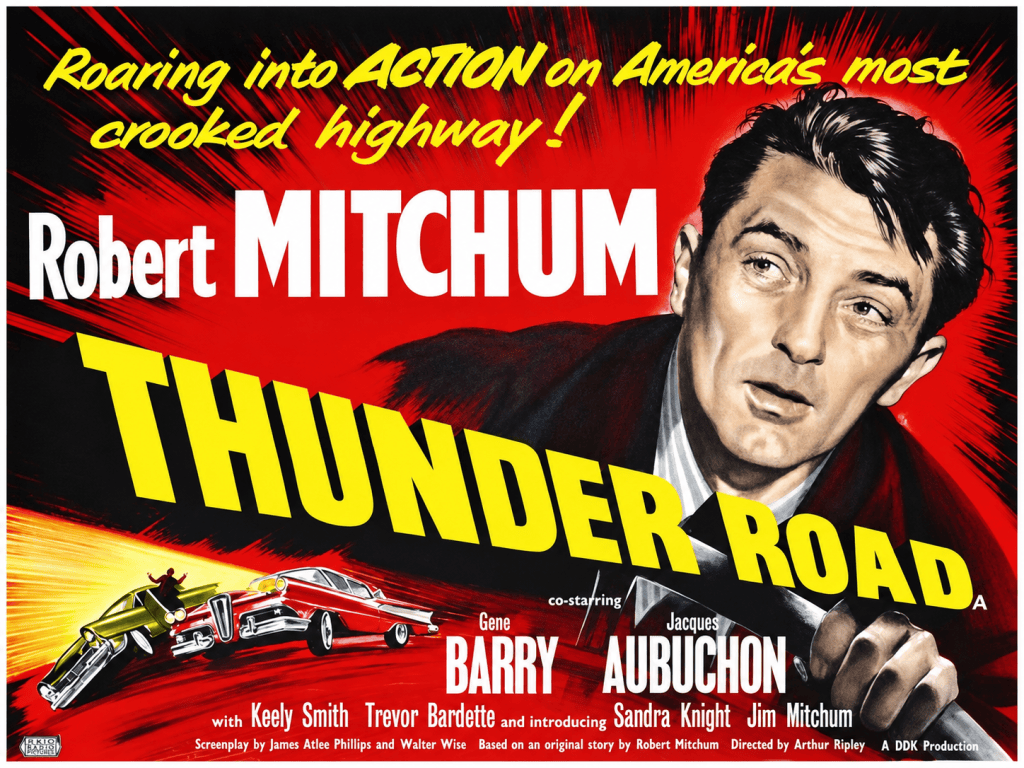
I knew ‘Thunder Road’ was about moonshine runners tearing through the backroads of the American South. They weren’t racing for pink slips or bragging rights. They were hauling illegal whiskey and outrunning federal agents. Right up my alley! But I wasn’t expecting a movie that explored themes of independence and freedom quite so deeply.
Mitchum plays protagonist Lucas Doolin, a man who’s returned from the Korean War, but isn’t the same man. While not suicidal, he mocks death by refusing to let the possibility of it change how he lives. He’s become hardened and detached, seemingly indifferent to his own survival when hauling moonshine. He’s accepted that his line of work will likely lead to his death, and those around him see his fatalistic attitude as insanity.


But Lucas is more than just a loose cannon. He demonstrates a deep love for his family, especially his younger brother (played by Mitchum’s son, Jim), whom Lucas refuses to allow into the family business. For generations, the Doolins have distilled and sold moonshine to pay the bills. But now, federal Treasury agents, whom locals call ‘revenuers’, are determined to shut down the operation because every gallon of untaxed whiskey means lost revenue for Uncle Sam.
And this is the crux of Doolin’s character. He went to war to fight for American freedom, only to return home and discover that his own government considers his family’s livelihood a crime! In Doolin’s mind, freedom includes the right to make a living from your own land without government interference. He’s disillusioned by the country he returned home to. Yet he’s stubborn enough to fight for his principles, even if it kills him.
Doolin’s weapon in his war against the taxman is a highly modified 1950 Ford. That car is the real star of ‘Thunder Road’! Hidden in the trunk and back seat is a 100-gallon moonshine tank, while a hot-rodded flathead V8 provides the power and reinforced suspension handles the extra weight. There’s an emergency valve to dump the whiskey if the cops get too close, a detachable rear bumper to defeat the Treasury agents’ bumper-grappler, and even a James Bond-esque oil sprayer to send pursuing vehicles sliding off the road. All that equipment, disguised in an ordinary Ford family sedan. Its looks just like a ‘stock’ car, but it’s a bootlegger’s dream machine!


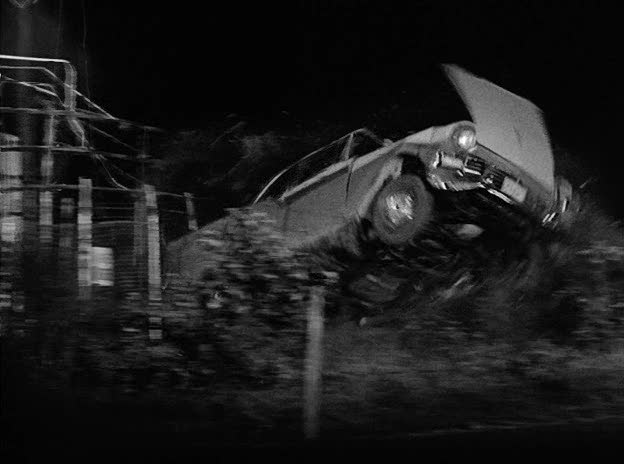
Traditionally, a B-movie was the lower-budget second feature at the drive-in, and ‘Thunder Road’ has all the hallmarks of a ’50s B-movie. Black-and-white photography, sensational subject matter, wooden performances from the supporting cast and a budget that clearly didn’t stretch far enough. There are some genuinely impressive driving sequences, including the spectacular final wreck featuring a real 1957 Ford flipping into utility poles. But those moments only make the studio scenes look worse. Outside the car, stunt drivers are risking their necks on narrow mountain roads. Inside, Mitchum sits stone-faced behind the wheel while the scenery speeds past at 100 mph! The contrast is so ridiculous that I found myself dreading every close-up of the driver.
‘Thunder Road’ was not a hit when theatrically released, but it found its audience at drive-ins throughout the 1960s. Its rebellious characters and death-defying driving helped establish a formula that later car-chase movies would embrace. More importantly, beneath the B-movie packaging is a surprisingly thoughtful story about family loyalty, personal freedom and a man who would rather die than surrender his independence. I wanted to love ‘Thunder Road’, and there’s a lot about it worth admiring. But every time Mitchum got behind the wheel, Hollywood put the brakes on my enjoyment.