
A true highpoint in Steve McQueen’s filmography ‘The Thomas Crown Affair‘ is super-stylish 60’s celluloid.
A bank heist movie with a twist, McQueen plays Crown, a multi-millionaire business tycoon who’s so bored with his life of art auctions and real-estate deals that he masterminds ‘the perfect crime’ by robbing the bank across the street from his ivory office tower. Crown conspires with five complete strangers to execute his robbery plan with Swiss watch-like precision. The robbers subdue security, grab a cash-transfer of $2.6 million in small bills, calmly walk out the front door and plop the loot in the back of a waiting getaway car.
Crown watches the action from his office window, then follows the non-descript getaway car to the drop off point in a cemetery. There, our protagonist pulls a wreath from the boot of his Rolls-Royce, and lays it at a gravestone as an excuse to deny involvement if the police followed him. Then, Crown calmly carries the cash (hiding in a trash can) to his car, and cruises home to his mansion.
Convinced the cops can’t crack this case, the insurance company send in their own investigator; the vivacious Vicki (played by fabulous Faye Dunaway).


She uses a high-tech “computer” to compare a list of bank customers with airline records, and discovers that Crown has repeatedly flown to Geneva, and hypothesizes that he’s deposited the millions into secret Swiss ”numbered bank accounts’. While continuing her investigation, Vicki falls for the sophisticated, cultured Thomas. The second act is pure romance, as the two lovers play a game of cat and mouse; she tries to pin the crime on him while they dine at the finest restaurants in Boston. Without spoiling the ending, once Vicki has Thomas dead-to-rights, he declares “I did it once. I can do it again” and tells her of his plan to rob the same bank again!
We wouldn’t be doing our duty here at Demaras Racing if we didn’t focus on the cars of this film, and the important role they play in establishing who characters are based on the vehicles they drive. Here’s a few favourites.
1967 Ferrari 275 GTS/4 Spyder
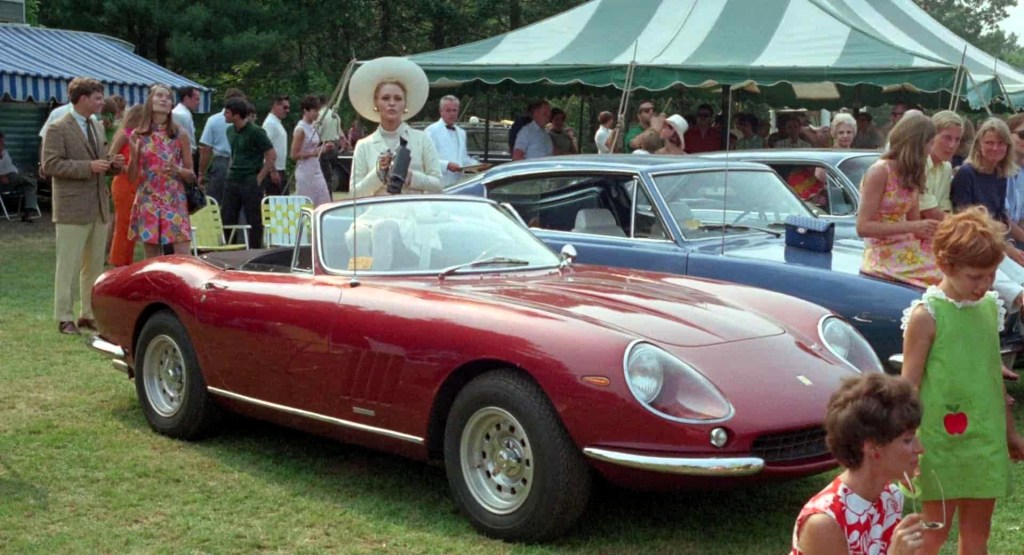
The star car is Vicki’s stunning 1967 Ferrari 275 GTS/4. The convertible, or ‘spyder’ as the Italians call them, was originally a yellow car but was repainted a more dignified Chianti Red for the movie. Fashionable Vicki gets to keep 10% of the cash she recovers from robberies and insurance fraud, and she’ll need every penny to fuel her prancing horse. The 275 GTS’s powerplant was a 12-cylinder, 3.2 L, four-cam beast fed by six carburetors. With a massive 300 HP, the featherweight Ferrari could top out at 165 MPH.


Stylish and elegant, the Ferrari 275 GTS was also a rare machine, as only 10 were built over two years of production. Today, a similar car would fetch over $4 million at auction, especially one with the provenance of such a movie car. McQueen admired the car so much during filming that he ordered himself one personally.
1967 Rolls-Royce Silver Shadow Fixed Head Sedan
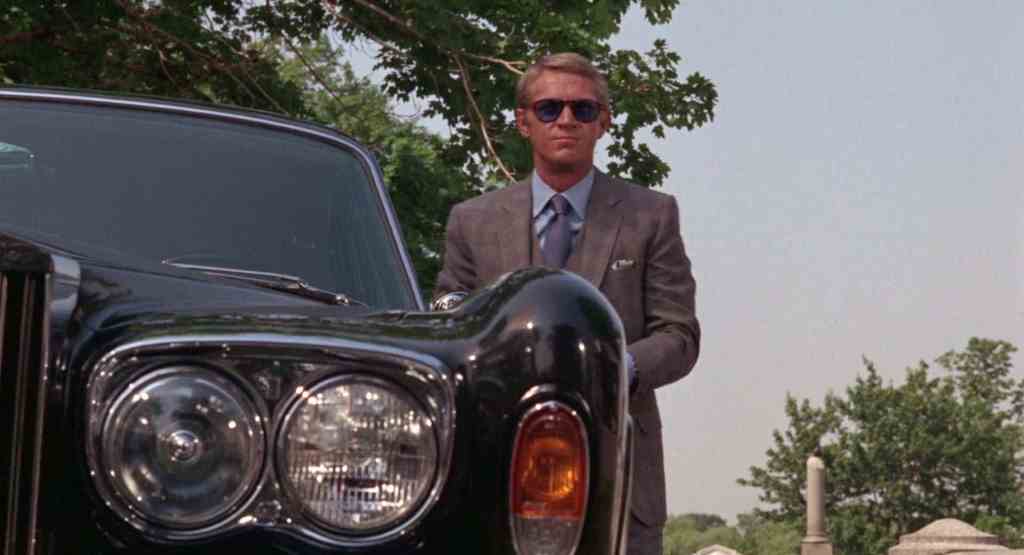
What did a captain of industry drive in 1967? A Rolls-Royce Silver Shadow, of course. The automotive symbol of wealth and status, this Rolls-Royce is a sporty, 2-door coupe (what the British call a ‘fixed-head’ simply means a hardtop, not a convertible) which is just perfect for a young, single, adrenaline junkie like Crown who gets his kicks from flying his ultralight glider. No wife or kids around means no stodgy four-door sedan needed. The Silver Shadow was powered by a 6.2 L displacement V8 engine which Rolls-Royce stated produced ‘adequate horsepower’ for the massive, all-steel car. Crown’s daily driver looked quite regal with it’s chrome trim accenting the Sapphire Blue Metallic paint, over parchment-coloured interior.


The car was on loan from movie producer Jerry Bresler (‘Pussycat, Pussycat, I Love You‘ 1967) and was indeed a rare bird. a rare bird. This Silver Shadow was 1-of-only-199 two-door sedans built in (American) left-hand drive by subsidiary coachbuilder H. J. Mulliner & Co.
1967 Meyers Manx Dune Buggy

The hero car of ‘The Thomas Crown Affair‘ is undoubtedly the Meyers Manx ‘dune buggy’ that Crown hoons at Ipswich Beach on the Massachusetts coastline, as a thrill-ride for his new girlfriend, Vicki. That’s really McQueen driving in those scenes, and that’s really Faye Dunaway’s screaming in delight. Director Norman Jewison’s iconic shot of a flock of birds scattering overhead, as the hero and heroine bound across the sand dunes, is as romantic as any French or Italian movie could ever be… at least to a gearhead.
The original screenplay called for Crown to be driving a Jeep in the beach scene, but McQueen decided on the Meyers Manx he’d seen in an issue of Hot Rod magazine. The dune buggy in the movie was custom built by BF Meyers & Co based on a Volkswagen Beetle chassis and featured a 240 HP, air-cooled, flat-six engine from the Chevrolet Corvair (GM’s infamous rear-engine car of the 60’s). The dune buggy also featured American Racing Equipment ‘knock off’ wheels with Firestone Racing tires wrapped around them. Yes, those are the same tires that the STP Special ‘turbine-car’ ran at the Indianapolis 500.


The original Meyers Manx Dune Buggies were designed and built for California desert racing by engineer, boat builder and surfer Bruce Meyers in his Fountain Valley, California shop from 1964 to 1971 before the taxman shut him down.
1967 Ford ‘Country Squire’ Station Wagon
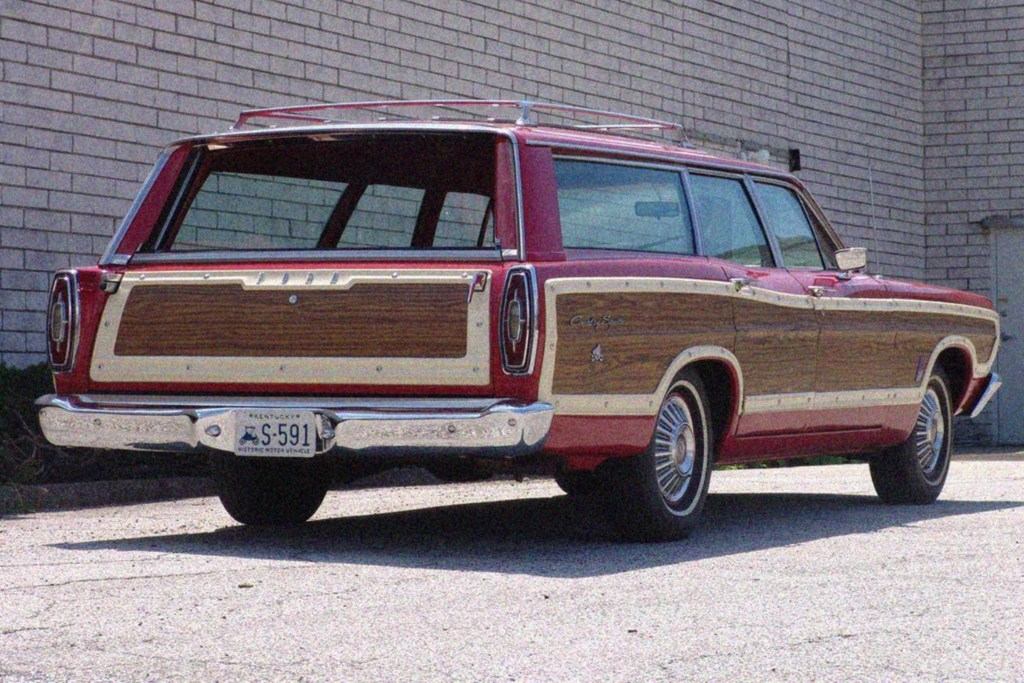
If there’s one thing movie-goers have learned from Steve McQueen movies like ‘The Getaway‘ it’s that driving a full-size, front-engine, rear-wheel-drive, V8 powered American car is mandatory if you’re going to get involved in some nefarious business.
In the opening scene of ‘The Thomas Crown Affair‘ our disguised protagonist meets with soon-to-be getaway driver Erwin (played by jittery Jack Weston). Crown tosses a manila envelope at the driver and instructs him to go buy a new Ford station wagon; “The big one.” Crown commands. Erwin follows the instructions and buys a Ford Country Squire station wagon in Vintage Burgundy with the deluxe and stylish woodgrain body trim. This was the top-of-the-line Ford model, something beyond the means of struggling Erwin. His wife must have known something was up!


The station wagon was equipped with a 7.0 L (428 cubic inch displacement, in American parlance) V8 engine paired with a Cruise-o-Matic automatic transmission. This was a suburban commuters dream come true, and would draw no attention from police looking for a speedy getaway car.
Interesting side-note, at Expo ’67 in Montreal, Canadian director Norman Jewison saw a short film by Christopher Chapman called ‘A Place To Stand‘ an Ontario government film promoting economic development. The short used a revolutionary “multi-dynamic image technique” allowing simultaneous actions on screen by projecting shifting images on moving panes. This split-screen breakthrough highly impressed Jewison, who then incorporated the technique into the already finished ‘The Thomas Crown Affair‘ before its theatrical release the following year.
The technique received acclaim as a new way of storytelling, and some believed it was the future of film. But Hollywood studios were concerned that audiences watching their movies on TV, years after theatrical release, simply wouldn’t be able to follow the multiple action scenes on tiny 21″ TV screens. Therefore, ‘The Thomas Crown Affair‘ remains a pioneering Hollywood movie for its use of an experimental technique. Above is the original, inspirational, Oscar-winning, Canadian short-film that helped inspire ‘The Thomas Crown Affair‘..
Great post, Chris. Lots of cool info about a cool movie.
That was a ‘Rubens Junior’ level post. In other words I REALLY tried to add in detail. Not just about the cars, but other interesting facts.
.
For example, the short film I mentioned called ‘A Place to Stand’ was something I’d seen as a little kid in public school. We all thought the short was SO 1960s, like the director was smoking the reefer. I found out now (30+ years later) that the short film heavily influenced one of my favourite movies of all time. Small world.