
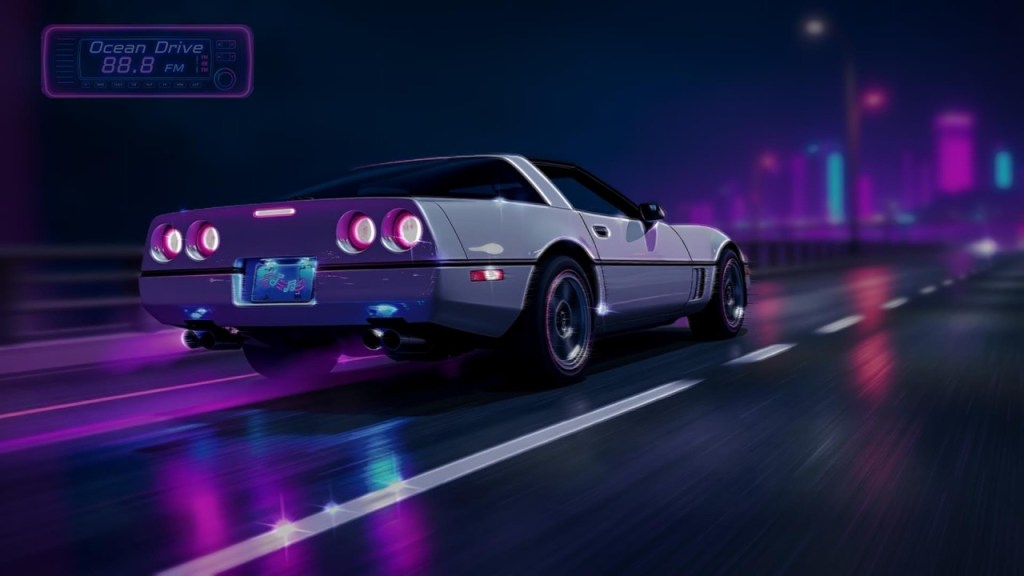
Synthwave as a music genre has a sound inspired by 1980s electronic music and video game sounds with a drum beat and bassline added. And the imagery is right out of a racing game from a 1980s video-arcade; wireframe vector graphics, hot pink and baby blue neon juxtaposed against a dark, desolate background, and always a sleek, wedge-shaped car featured prominently.


Retro-futurism is what we expected tomorrow to look like, yesterday. The choice of vehicles in synthwave imagery to create a futuristic look is interesting because of the predominance of Brutalist style cars. Brutalism disregards tradition and rejects ornamentation. Some may consider Brutalist design cold and harsh, prioritizing function over form. But in terms of car design, the 1970 Ferrari Modulo’s sleek Brutalist looks are still futuristic at fifty-five years old.
Brutalism also focuses on displaying raw materials themselves, such as the slab of stainless-steel that is the hood of the 1981-1983 DeLorean DMC-12. The unpainted, reflective skin of this vehicle made it the poster-child for synthwave imagery, and its BTTF movie role solidified it as the car of the 1980s.

Another example of Brutalist car design is the austere 1984-1996 C4 Corvette. Compared to the swoopy body lines and arched fenders of the 3rd-gen Corvette it replaced, the C4 looks modern, sleek and streamlined.
The Lamborghini Countach was introduced in 1974 but became synonymous with 1980s excess. The shape was more angular and geometric in design to cars of the era. The wedge-shaped vehicle had a low, flat front, chopped tail and angular details. Even the unconventional scissor-door were a break from tradition.

The Ferrari Testarossa produced from 1984 to 1991 is the original vehicle from the ‘OutRun‘ vide game, and deserves a special mention. The horizontal strakes on the doors are functional air intakes for the 12 cylinder engine in the back. While it does not look like a folded piece of sheet-metal like the DeLorean, the Testarossa’s appearance is both retro and futuristic.

Brutalism began as an architectural style from the 1950s, which focused on minimalism, angular shapes, and the honesty of exposed structural elements. Imposing and geometric, Brutalism isn’t exactly beautiful (just look at the Cybertruck) yet a sleek, Brutalist sports car posed against neon-noir background still means ‘the future‘ even today.
I never cared for brutalist designs. The blockiness and angular features always look clunky to me. Although I like Cubism.
I hear you. And I just don’t know why I like it so much. The eye should be drawn to smooth, curvaceous shapes (read into that whatever you want) but this look of folded tin foil … I like it!
I can understand the appeal. One angular car I really liked was the Pantera.
See, now you’re speaking my language!
.
A lot of those late-60’s & early-70’s wedge cars were the definition of cool. But the Pantera was a cut above!
.
Just imagine being able to walk into your local Ford dealer and buy an Italian exotic with a 351 Cleveland V8 that you could wrench on in your driveway.
Absolutely.
Excellent analysis, Chris; it’s spot on. This style movement deserves more attention.
I only recently read the definition of brutalism as a style (you know, because of the movie ‘The Brutalist’) but I have always liked the style.
.
Brutalism in car design looks so futuristic. And it’s been long enough since the 80s and 90s that I can now look at the designs and see how cool they really were. Cars afterwards just looked like jelly beans (Ford Taurus).
.
https://demaras.com/2024/08/14/oblivion-vi-cool-cars-of-the-80s/
.
…and…
.
https://demaras.com/2024/08/15/oblivion-vi-retro-rides-of-the-90s/