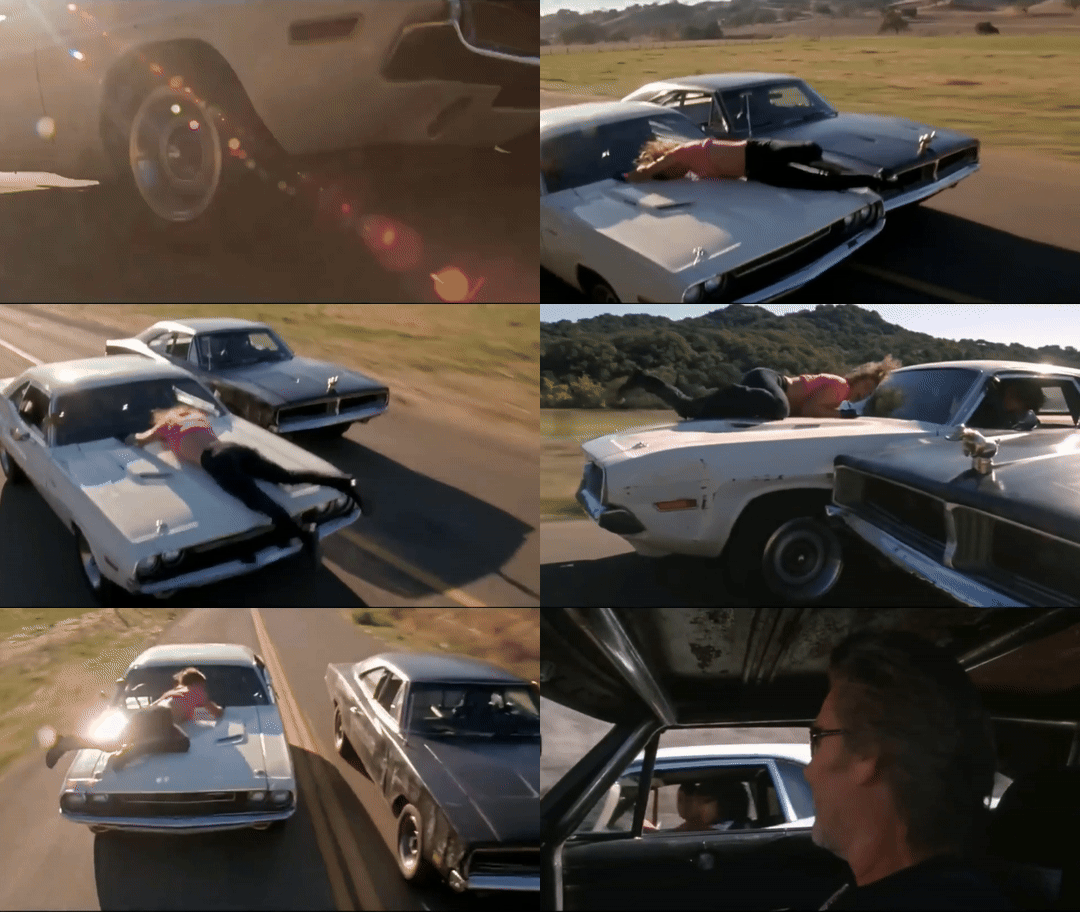
Quentin Tarantino is a movie nerd. While working at a video rental store, before making it as a director, he developed the ability to identify the title of any movie just from the description on the back of the VHS box.
It’s interesting that his film knowledge, including B-movies and exploitation films, influenced his work. His 2007 film ‘Death Proof‘ is a tribute to the low-budget, car-crash flicks of the 1970s, and each vehicle in the film references a great movie car of the past. Some of the nods are subtle, so here’s some details that might speed right past you.
1971 Chevrolet Nova SS


The Nova isn’t classic American muscle like a Charger or Challenger. But that makes it ideal as Stuntman Mike’s car. Without that skull and crossbones on the hood, this non-descript type of car that would have been perfect for a crash scene in “The French Connection“. The Nova is the ‘hero car’ of the film, and the audience gets to see firsthand the safety features built into stunt cars. A full roll cage, containment seat, and plexiglass protection cell make the car ‘death-proof’ for the driver. To show his love of car chase flicks, Tarantino used the same California license plate JJZ-109 as Steve McQueen’s iconic 1968 Mustang GT from “Bullitt” and the chromed rubber-ducky hood from the Mack truck in Chris Christofferson’s 1978 trucksploitation film “Convoy“.
1972 Ford Mustang Mach I ‘Grande’


Gearheads define the Mustang a ‘pony car’ with agile handling due to its smaller size, as opposed to a ‘muscle car’ which is a full-size vehicles with powerful V8s focused on straight-line speed. The Mustang ‘Grande‘ is almost 4″ longer than the regular Mustang, and featured a luxury interior trim with simulated wood dashboard and artificial leather bucket seats. This car is a direct reference to the yellow 1973 Ford Mustang codenamed ‘Eleanor’ from the 1974 original “Gone in 60 Seconds“. Tarantino has even references his own movie, as the Mustang’s yellow paint mimics the 2000 Chevy Silverado ‘Pussy Wagon‘ from “Kill Bill: Vol. 1” and upon closer look, even has a pink ‘Lil’ Pussy Wagon‘ decal on the tailgate.
1969 Dodge Charger R/T


A year after Stuntman Mike’s kill-crazy rampage, he’s back at it, hunting down the lone survivor from his last attack. This time his chrome rubber-ducky is on the hood of a black 1969 Dodge Charger R/T with the sinister looking covered headlights. The Charger is part of Hollywood mythology; it’s the bad guy’s car driven by stunt driver Bill Hickman in the famous “Bullitt” chase scene. Tarantino took it one step further, making the car a blacked-out clone of the General Lee from TV’s “The Dukes of Hazard” complete with ten-spoke American Racing brand ‘Vector’ rims. Not meta enough? The Charger has the same 938-DAN license plate as the and the same number plate as the hi-viz Limelight coloured 1971 Charger from “Dirty Mary, Crazy Larry” that Peter Fonda drives.
1970 Dodge Challenger 440 Magnum


In the final chapter of “Death Proof” antagonist Stuntman Mike attacks four damsels in distress. He’s in his black Charger and attacks the women test driving a white Challenger; a battle of good vs evil. Boy, did he ever pick the wrong ladies to mess with! The girl’s car in “Death Proof” is a direct reference to “Vanishing Point” the 1971 existentialist road movie. The vehicle is the same year, make, model and colour as the one protagonist Kowalski drove across the desert in his search for meaning in a meaningless world. The fact the white car is the same as the one from “Vanishing Point” is actually mentioned in dialog between characters Kim and Zoe, the latter being real-life stunt driver Zoe Bell who also drove the Challenger, flipped Stuntman Mike’s car then helped beat him to death in revenge.
“Death Proof” was not as critically successful as Tarantino’s other films. And financially it barely mad be back its $30 million production budget. But to gearheads, it’s the Palme d’Or of car-crash flicks.
1 thought on “Cool Cars of Tarantino’s ‘Death Proof’ (2007)”