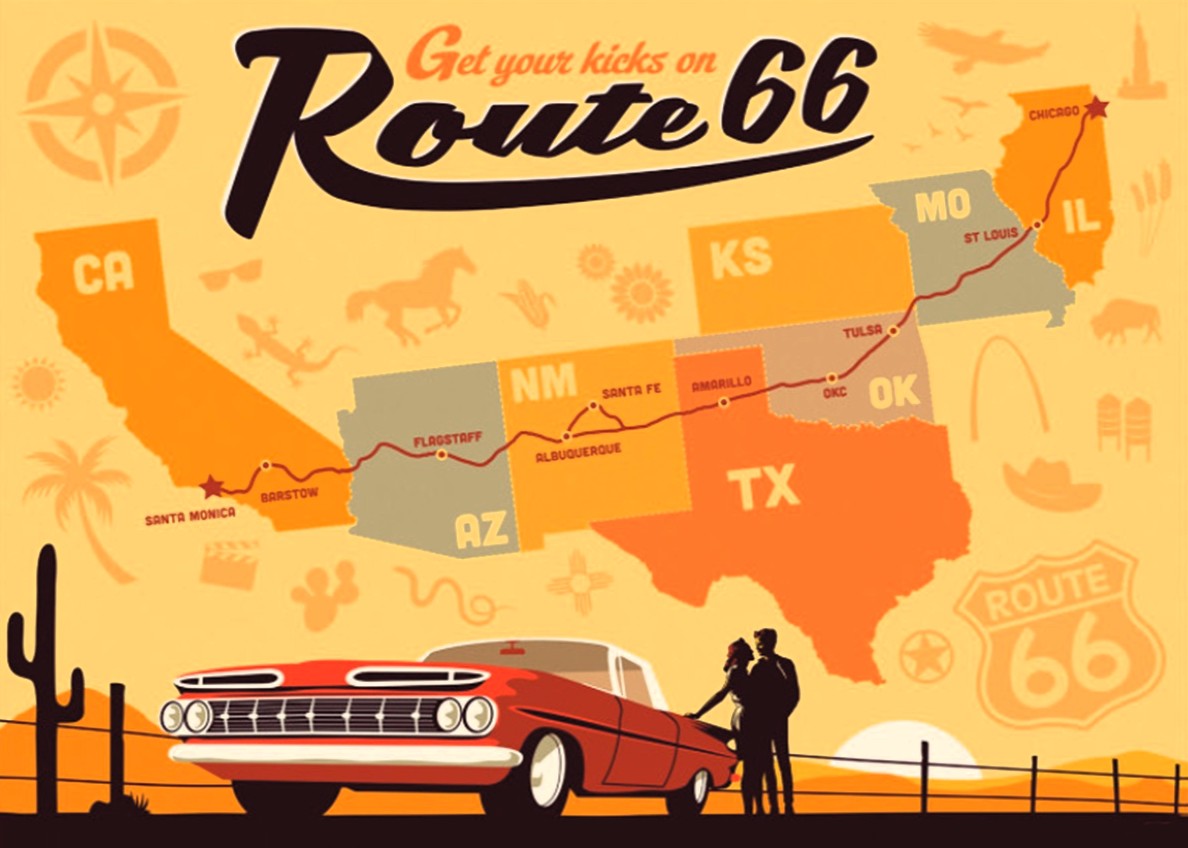
Some people get statues. Some get chapters in history books. Others change the way an entire country moves, dreams, eats, drives and vacations, then somehow vanish into the background like an extra in their own movie. Cyrus Avery belongs in that last category. Avery was an Oklahoma businessman from Tulsa, who if he even is remembered now, is known as the ‘Father of Route 66’.
In the 1920s, as America was trying to make sense of the automobile age, Avery helped push for a highway that would connect Chicago to Los Angeles, running through the heart of the country instead of around it. Route 66 was officially established in 1926, stretching roughly 2,400 miles across eight states, and this year marks its 100th anniversary.
That deserves more than a souvenir magnet.


Route 66 was not just pavement. It was possibility. It linked small towns, diners, gas stations, motels and service garages into one long ribbon of motion. For rural communities, it brought customers. For travellers, it brought freedom. For dreamers, it offered the idea that somewhere farther west, life might be brighter, warmer, stranger or at least more photogenic.
Eventually, Route 66 became more than a highway. It became mythology. John Steinbeck called it the ‘Mother Road’ in ‘The Grapes of Wrath.’ Jack Kerouac helped turn the open road into a symbol of rebellion and self-discovery, even if some of us will admit we have not actually read his famous scroll. The point still stands. Route 66 helped create the Great American Road Trip, that sacred ritual of packing the family car and pretending a folded paper map was better than GPS.
Then came the interstates. Faster roads. Straighter roads. Roads that bypassed the very towns Route 66 had once brought to life. By 1985, Route 66 was officially decommissioned, but it never really died. It just became a ghost road, haunted by neon signs, crumbling motels, old pumps, burger stands and the stubborn romance of chrome bumpers under desert skies.
And then, somehow, along came Lightning McQueen.


Pixar’s ‘Cars’ understood Route 66 better than most history lessons ever could. Radiator Springs was not really about talking cars. It was about a town bypassed by progress, forgotten by speed and rediscovered by someone who needed to slow down. The film pulled directly from the spirit of Route 66 and its real roadside culture, from old motels and service stations to the strange beauty of places that survived because people cared enough to stop.
That is why a family vacation to California can become a pilgrimage. Cars Land at Disney California Adventure recreates Radiator Springs so lovingly that fans do not just see a movie set. They see the emotional version of Route 66. For some families, that connection continues beyond Disney with stops along the old road at the Wigwam Motel, the original McDonald’s in San Bernardino and the historic Richfield Service Station in Rancho Cucamonga.


Cyrus Avery could never have imagined Lightning McQueen. He could not have predicted Cars Land, Instagram road trips or a Canadian racing family chasing Route 66 landmarks across California. But his vision made all of it possible.
Underrated people in history are not always the loudest names. Sometimes they are the ones who build the road, then let the rest of us find ourselves on it.


66 is like no other highway! Its a legend and fond memories for anyone that takes it 😎😎😎
We traveled on route 66 part of Arizona last winter! Yes, it is not about the route but the towns that lost their businesses!
Progress is a steamroller that feels no nostalgia. People, on the other hand, we feel longing for a time we never experienced. Who wouldn’t want to travel back in time to Route 66’s heyday.