
The Parking Lot Social Club
Go back and watch ‘American Graffiti‘ or ‘Dazed and Confused‘ and you’ll notice that the pastime of cruising has all but disappeared.
Back in the 1950s and ’60s, cruising wasn’t just something young people did on a Friday night. It was a cultural phenomenon. The automobile was still relatively new, freedom was intoxicating, and teenagers suddenly had the ability to travel beyond the limits of their own neighbourhood. Cars weren’t simply transportation. They were opportunity.
Through the 1970s and ’80s, the automobile remained the centre of social life. If boys wanted to meet girls, they had to leave the house and go where the girls were. If girls wanted to be noticed, they had to show up, too. The local strip, burger stand, parking lot or drive-in became the social network of its era.


Then came the internet.
First chat rooms, then social media, then smartphones. Suddenly, people no longer needed to drive around looking for something to do. The party moved into a screen that fits in your pocket. Whether that’s progress or tragedy is up for debate, but it’s difficult to argue that an iPhone has ever been as exciting as a set of car keys.
Toronto presents another challenge: sheer size.
Cruising worked when a city had one downtown, one main street where everybody gathered. Toronto passed two million people years ago, while the GTA has swelled to nearly seven million. There isn’t one strip anymore. There are dozens of them. And even if there were, who wants to spend an hour crawling through construction zones just to get there? Half the roads seem permanently adorned with orange pylons guarding projects nobody can quite remember the beginning of. Finding an open lane has become a scavenger hunt.
Which brings us to the modern car meet.


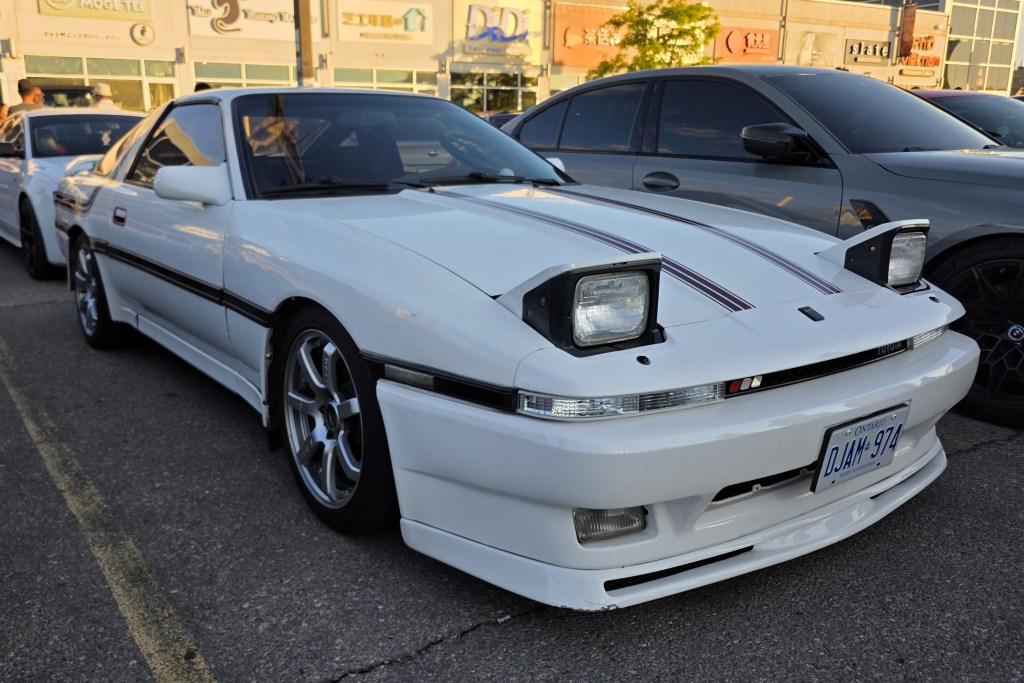
What politicians occasionally describe as “unsanctioned car rallies” are, in reality, often little more than a few dozen enthusiasts gathering in a Timmies parking lot on a Friday night after school or work. Cars are parked. Hoods are opened. Stories are exchanged. Friendships are made.
In many ways, car meets have become the modern version of cruising.
What’s particularly interesting is which cars earn respect among younger enthusiasts. The broccoli-haired crowd seems convinced that a BMW with a rattling exhaust and enough pops and bangs to startle wildlife is irresistible. Evidence supporting this theory remains remarkably difficult to find.
Perhaps even more notable is the near-complete absence of domestic cars. Outside of the occasional Corvette, the overwhelming majority of vehicles are Japanese or at least Asian in origin. Honda, Toyota, Nissan, Mazda and Subaru dominate the landscape. Every generation decides for itself what’s cool, and today’s enthusiasts have clearly made their choice.

At the random SkyCity meet where these photos were taken, one car stood apart from the rest: a black Grand National. Its owner wasn’t memorable because of his grey hair. He was memorable because he brought beach chairs.
He parked the Buick, popped the hood, unfolded a pair of lawn chairs and settled in for the evening. While everyone else wandered around the lot checking out cars, he essentially transformed himself into a one-man information booth dedicated to the history of turbocharged Buicks.


And that’s the part some people miss. Yes, car meets replaced cruising. Yes, cars remain the centrepiece. But the vehicles are only half the story.
The real reason people keep showing up at car meets is the same reason they always did. The cars are the attraction. The conversation is the destination.