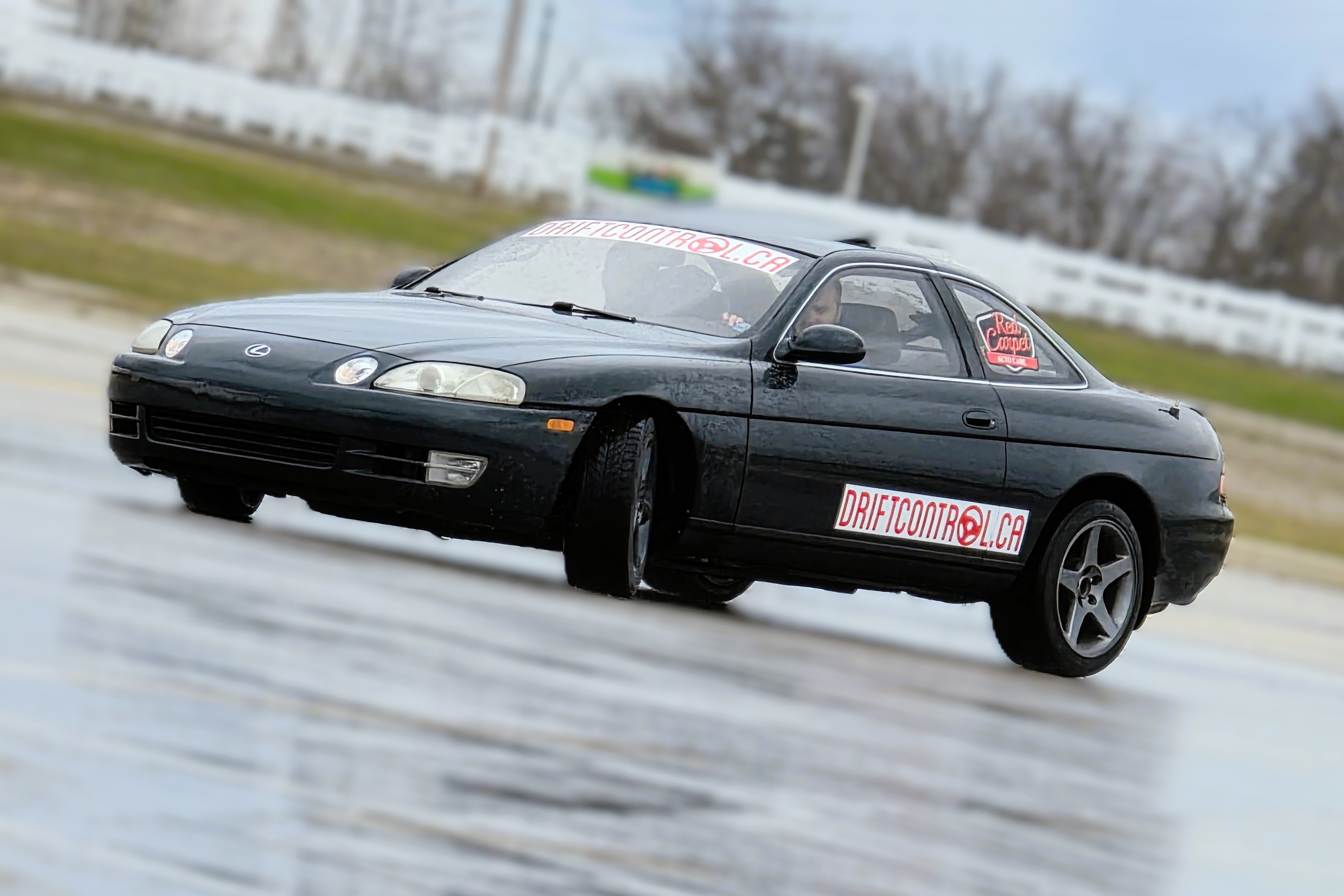
The first ‘drifting class‘ of 2025 was held by the DRIFT CONTROL school, out in the country at the Essa Agriplex an hour north of Toronto, the sound of hi-revving engines and tires screeching did spook some of the horses. But other than that, it was a fun event that posed no danger to the public. It put smiles on drivers faces while they learned enhanced car control.


When you spend enough time at the track, you’ll realize that skill sets are transferable. Racing on a road course is very different from an oval track, but principles of cornering, clipping an apex, and the importance of weight transfer apply everywhere. Except drifting. Drifting is counter-intuitive madness.
After the drivers meeting, drift guru Nelson explained the basics of drifting. The first thing the class noted was that holding a steering wheel was different. Rather than a firm grip and hand-over-hand technique, in drifting, the driver lets go of the wheel and ‘throws’ it into a spin. Breaking the habit of how to hold the wheel would be only the first of many challenges.

First up, students were seated in a 1993 Lexus SC400 sports coupe. Despite this being a luxurious Japanese car, it seemed very American. Long wheelbase, rear-wheel-drive and a big V8 up front. Like Toyota’s version of a Mustang or something. Nelson rode shotgun with each student, and explained how to initiate a drift in the big car, which was a combination of weight transfer, throttle application and quick hands. Once the car was drifting, it was reasonably easy to maintain the drift all the way around the skid pad.


Once the ‘starter’ car was put away, Nelson brought out the 1997 NA Mazda Miata. A completely different vehicle in every way, the Miata is small, light, short-wheelbase and equipped with a manual gearbox. Getting the Miata to drift took zero effort; just turn the wheel, floor the gas pedal and the four-cylinder engine lights up the rear tires. But the car is so short from bumper-to-bumper that modulating the throttle to keep the car going sideways was way more difficult.
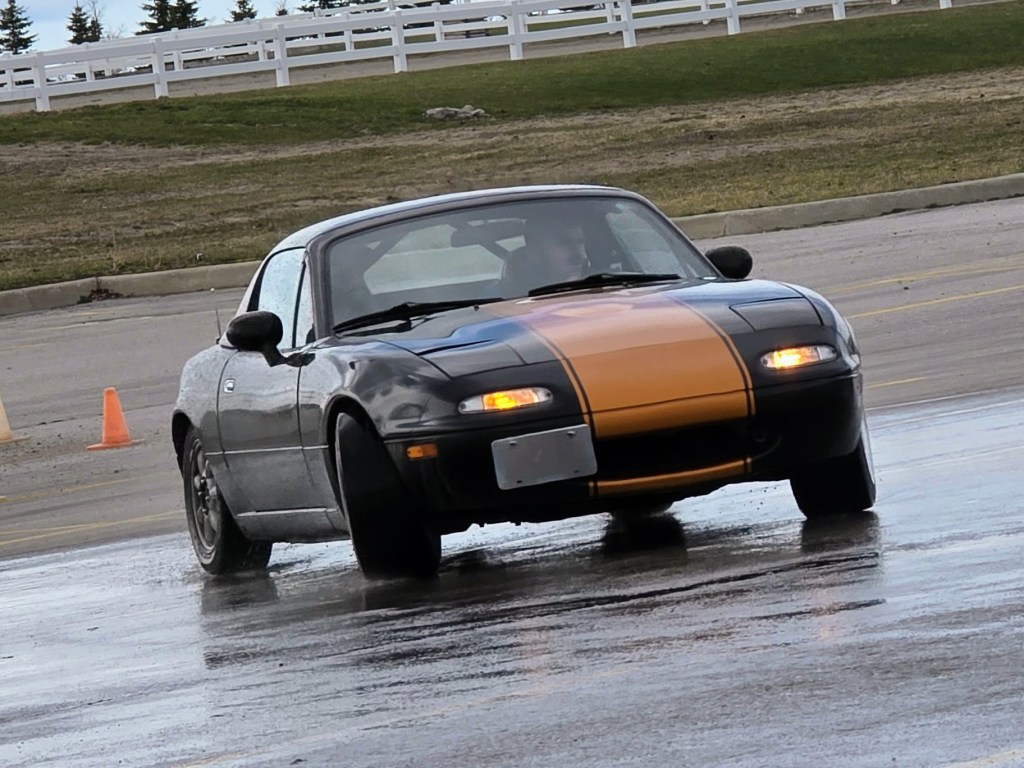
Driving exercises progressed in difficulty throughout the day. Initially, students struggled just to get sideways. From there the challenge was to maintain a drift around a pylon for multiple revolutions. Once mastered, transitioning from clockwise to counter-clockwise drift around a figure-8 layout was the next step. While difficult, Drift Control school was never boring.


With only 5 students and 2 cars, you certainly got your money’s worth. Even being out of the car and just watching other drivers do their thing was useful. It, helped assuage fears about being the dunce of the class, but also gave the opportunity to see and hear the throttle control on a proper drift.
While it might not look like it, drifting has real-world driving application. Getting accustomed to the feeling of weight transfer, as a car begins to drift, can be frightening at first. But after 50 or 60 tries, you get used to the sensation.
It’s just like like Han said to Sean in ‘Fast & Furious: Tokyo Drift‘. There is no “wax on, wax off” with drifting. You learn by doing it. So, if the back end of you car started to come around on a slippery highway on ramp, the DRIFT CONTROL course would teach you not to panic. You might even put your foot in it to see if you could hang the tail out.
That looks pretty cool, and a little bit scary. I learned “turn in the direction of the skid” which might be ohioan for “how to drift.”
It was scary, Susan! Learning to ‘catch’ a slide or skid is one thing. Flooring the gas pedal to keep it going, sideways, is very counter-intuitive.
.
Never felt like crashing (nothing to hut) but getting your hands and feels to do something yiu know feels wrong is challenging.
.
The big car, the Lexus, was so much better.
Mazda RX-8s are great cars for drifting because of their high RPMs and rearwheel drive.
Mazda makes some cool cars!
.
I went to some drift events last summer and there were RX-7 & RX-8 out on track. High winding rotary is just ideal for drifting.