
This 1914 Charlie Chaplin short movie was the first film appearance of his iconic Little Tramp character. Directed by Henry Lehrman, the movie portrays the Tramp as an over-enthusiastic race fan at the real-life Junior Vanderbilt Cup. Shot on January 11 1914, crowds had gathered in Venice, California for a kiddie car race, sort of a predecessor to modern go-kart racing.


Throughout the event, the attention-thirsty Tramp in his baggy slacks, tiny coat and bowler hat, keeps stepping in front of the newsreel cameras. The film is presented at first like a genuine newsreel, with Chaplin’s seemingly drunk character dead-eye staring into the lens. ‘Kid Auto Races at Venice’ was theatrically released on February 7 1914, when the rest of the world met the Little Tramp for the very first time.
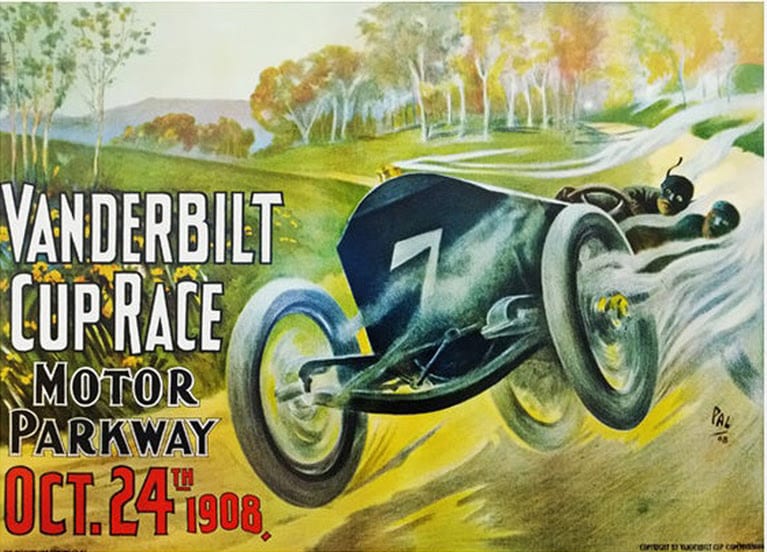
Historically speaking, the Vanderbilt Cup was the most important motor race n America, attracting international competitors. Created by William Kissam Vanderbilt, the first race was held in Long Island, New York, in 1904. After 1911 the race moved Georgia, later Wisconsin, then eventually California where the local town council dreamt up a youth version of the race. The Junior Vanderbilt Cup had classes for homemade cars (with age limits for drivers) powered by twin-cylinder engines, single-cylinder engines and ‘soap box derby’ no-engine cars that were sent down a ramp to pick-up speed. After 1914 no further Junior Vanderbilt Cup races were held, so the Chaplin film actually captured a piece of motor racing history.


Young racers in the Junior Vanderbilt Cup received actual silver cups too; miniature versions of the original Vanderbilt Cup Trophy, which was a 2½’ tall silver cup with the image of William K. Vanderbilt II driving Mercedes at the Daytona Beach Road Course.
While the original Vanderbilt Cup trophy is stored at a Smithsonian and rarely seen by the public, there is an interesting modern connection. In 1996 the Champ Car open-wheel racing series (predecessor to today’s IndyCar Series) wanted to enhance the appeal of their new U.S. 500 race in Michigan. In recognition of William Kissam Vanderbilt’s place in racing history, Champ Car had an exact duplicate of the original Vanderbilt Cup cast in silver as the winner’s trophy for the race.


It later became the National Champion’s trophy for Champ Car from 2000 until 2007, with the final name inscribed on it being Newman/Haas/Lanigan Racing driver Sebastien Bourdais. In 2008, the Vanderbilt Cup copy was replaced by the original 1915 Astor Cup which has since had all the championship winning drivers and teams since 1909 engraved on its marble base.